

For those who are discovering RAID (Redundant Array of Inexpensive Disks), it is a hard disk installation that stores data on multiple hard disks simultaneously.
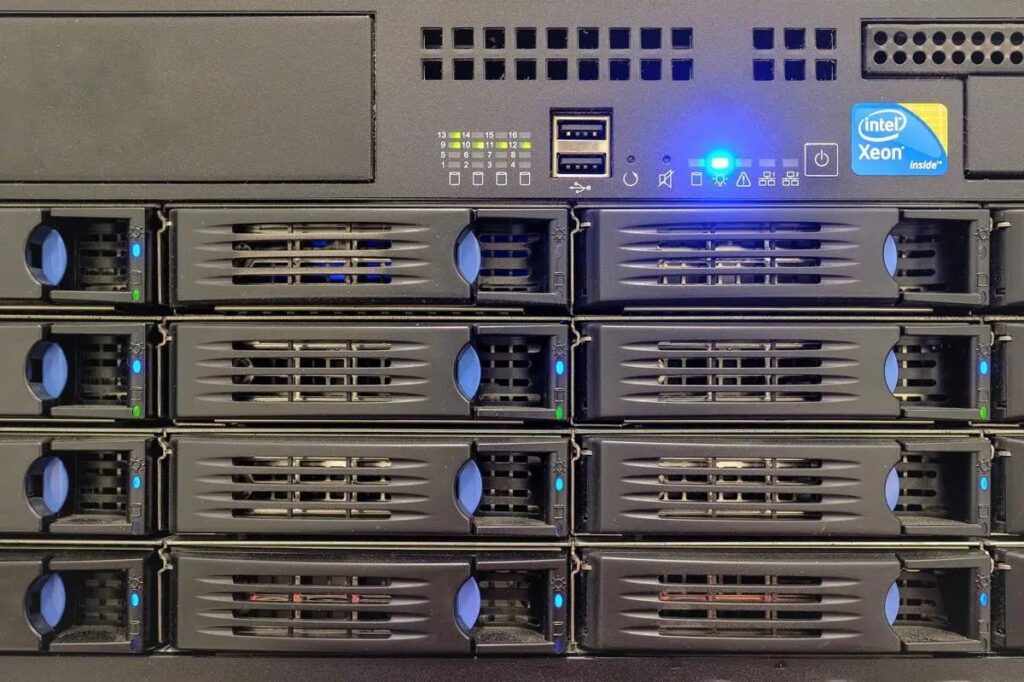
There are different types of RAID with varying levels of data redundancy managed in very different ways. RAID 1 and RAID 5 are the most well-known. Each RAID system has its advantages and disadvantages.
This provides a degree of fault tolerance since the data is copied multiple times, and can improve performance (read and/or write) depending on the RAID configuration chosen. Like any hardware, even a RAID 5 array in a server or NAS can fail at various levels (hardware or software).
The problem is that a RAID array often contains sensitive data. It’s not the kind of computer system you set up for fun. You’ll often need to go through a specialized laboratory if you want to recover data from this type of system.
What should you do if your RAID setup fails?
Try to identify the problem
Don’t take any RAID failure lightly. Some configurations are so complex that improper handling could seriously worsen the situation and result in data loss.
Most manufacturers, such as Dell , have web pages that can help you understand and troubleshoot hard drive and RAID issues. If you lack the necessary expertise in-house, don’t hesitate to contact a specialist company.
If the problem appears to be with a hard drive
Choosing the right replacement disc
If the hard drive is faulty, try replacing it with one of the same model. Check the part number on the manufacturer’s label. If you don’t have an identical model, choose a drive that is at least the same size as the faulty one.
Remember, two hard drive models sold with the same storage capacity (1, 2, 4, 6, or 8 TB) may not have the same usable space once installed and formatted. In other words, a 2 TB drive from brand A could offer less space than a 2 TB drive from brand B.
Hot or cold disc replacement?
Some RAID configurations allow for hot-swapping (hot-swapping) of a hard drive (i.e., the system is powered on and running), but this isn’t always the case. If you’re unsure about this feature, it’s best to shut down your system before replacing the hard drive.
Upon restarting, if the hard drive has at least as much free space as the failed drive, it will be possible to begin rebuilding your RAID array. There is also a risk at this stage, as the rebuild will take several hours. If another technical problem were to occur during the rebuild, it would only worsen the situation.
Can you try to recover the data yourself?
Given the complexity of a Raid installation, trying to “hack” your installation or any Raid recovery software to recover your data is more than risky, even dangerous for the long-term security of your data.
Using specialized data recovery laboratories is often the best option.
How much does data recovery cost on a RAID system?
Unlike “simple” data recovery on a traditionally installed hard drive, the methodology and difficulty are much greater on a RAID array of disks.
It’s difficult to give a price for data recovery from RAID arrays because the complexity for the service provider will vary depending on the RAID type, the number of disks, and the type of failure. However, expect to pay several thousand euros.
How to choose the right service provider to restore your files?
In France, there are about ten reputable companies in this field. Not all of them specialize, are equipped, or are trained for RAID restoration. This is the first point that might help you narrow down your choices. There are also customer reviews, but you still need to be able to identify reviews from customers who have experienced a RAID system failure, as it’s quite a specific issue.
Then there’s the issue of price transparency, which isn’t always the case. Also worth noting is that these labs offer to send your discs for analysis and cost evaluation. Some even refuse discs that have already been analyzed by another lab.
Before submitting the procedure, inquire about the cost of retrieving your discs if you are not satisfied with the outcome. Avoid phone calls and request an email instead to have a written record to prevent any potential disputes.
Finally, these specialized companies sometimes only have a sales office in France where they receive the hard drives, which are then shipped to another country: where the laboratory is located. This is important to know because some people don’t appreciate their data leaving the country (not to mention the additional risks associated with transport).

